Manga
The manga that were hits in Japan in the 2010s.
2010S HITS

About
After a disastrous defeat at the 2018 World Cup, Japan's team struggles to regroup. But what's missing? An absolute Ace Striker, who can guide them to the win. The Japan Football Union is hell-bent on creating a striker who hungers for goals and thirsts for victory, and who can be the decisive instrument in turning around a losing match...and to do so, they've gathered 300 of Japan's best and brightest youth players. Who will emerge to lead the team...and will they be able to out-muscle and out-ego everyone who stands in their way?
Character analysis
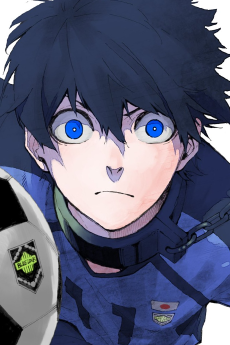
Isagi is haunted by a single moment where he passed instead of shooting, costing his team a win, and that regret is what gets him recruited into Blue Lock's brutal program to manufacture Japan's most selfish, effective striker. His arc is about learning to trust his own instinct to shoot rather than deferring to the team around him.

Bachira plays with a chaotic, almost feral unpredictability that even he doesn't fully understand, describing his need to dribble past everyone as a monster inside him. His strange, intense bond with Isagi, built on recognizing something similarly unconventional in each other, becomes one of the story's most memorable rivalries.

Rin is enormously talented and openly contemptuous of teammates he considers beneath him, a coldness rooted in his famous older brother's own history. His arc tests whether Blue Lock's whole philosophy of isolated genius can survive contact with someone who might actually be able to match him.

Nagi has natural technical ability far beyond most of the cast, but he's profoundly apathetic and would rather be doing almost anything else than play seriously. Bachira is the one person who manages to drag real engagement and ambition out of him, which becomes the spark for one of the story's most dangerous partnerships.

Ego designed the entire Blue Lock program around a controversial belief, that Japan needs one supremely selfish, egotistical striker rather than a team of well-rounded players. His manipulative, often cruel methods make him as much an antagonist to the cast as any rival team.
Status evaluation
Intense facial expressions and dynamic match sequences give the art a heightened, psychologically charged energy.
The premise of manufacturing a selfish striker through psychological pressure gives this a sharper hook than most sports stories.
The tone stays intensely serious throughout, with very little room for comic relief.
Rivalries and personal backstories add real stakes, though the series leans more on tension than sustained sadness.
The psychological intensity can feel unsettling, though there is no literal horror content.
This is a soccer story with no real violence.
A large rotating cast of strikers and shifting team formations take some attention to track.
This figure has not been verified against a current source and should be treated as approximate.
“A soccer story that treats passing the ball like a moral failure. I did not expect to find that premise this gripping.”